Buying Matcha in Australia: A Ten-Point Checklist
Taka KanekoEvery answer should be on the packet. That is the rule we teach in the workshop for reading a tea label, and it is the whole of this post: ten things to check before you buy matcha in Australia, in the order you meet them on the tin. None of them needs a tasting. They need a label, and about two minutes.
It is written by Taka Kaneko, founder of EdoMatcha and one of only two Japanese Tea Instructors in Australia certified by the NPO Nihoncha Instructor Association. The examples are our own tins because those are the ones whose labels we can vouch for.
1. The region is named
Matcha comes from a place, and a seller who knows the place says so. Look for a region, and better still a town: Ujitawara in Kyoto, or Chiran in Kagoshima, rather than "Japan" alone. A single farm or a single cultivar is better again. A tin that says only "green tea powder" is hiding somewhere, and the somewhere is usually the price.
2. It says first harvest
First harvest, ichibancha, spring picked: any of those three phrases is the quality tell, because the year's first picking is the youngest, sweetest leaf and every later picking turns coarser and more astringent. This is the difference you taste, and it matters more than the grade word on the front. If the harvest is not stated, assume it is not the first.
3. The cultivar is named
A cultivar is the variety of tea plant, and a grower who names it (Yabukita, Okumidori, Saemidori, Samidori, Komakage) is telling you they know exactly what was picked. It is a small line on the label and a large signal about the seller. Our Kagoshima matcha is a single cultivar, Okumidori; the Kyoto tins list the five that go into them.
4. It was shaded, and for how long
Matcha is made from tea that spends its last weeks before harvest under shade. Shading is what builds the sweetness and the colour, and it is the single step that separates matcha from ordinary powdered green tea. A good label says shaded, and a better one says for how long. Our Kyoto matcha is shade-grown for at least twenty days.
5. It was stone-milled
The three words a matcha label should carry are shaded, first harvest and stone-milled. Real matcha is deveined and stone-ground to a micro-fine powder, and a label that says so is telling you the leaf was made into matcha the slow way. If the packet says nothing about how it was ground, that is an answer too.
6. The word ceremonial proves nothing on its own
"Ceremonial" has no legal definition. Anyone can print it. The three words in point 5 do the work the grade word claims to do, so read past it. Our longer explanation is in Ceremonial vs Culinary Grade Matcha, including what does separate the two.
7. Organic means the JAS logo, not the word
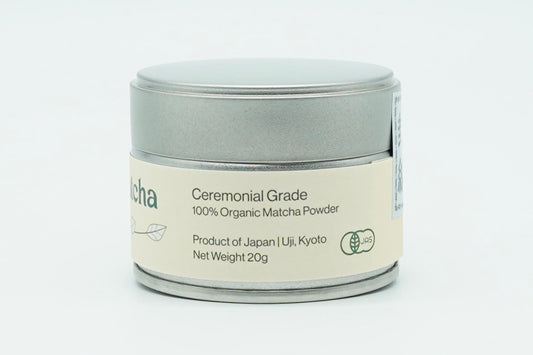
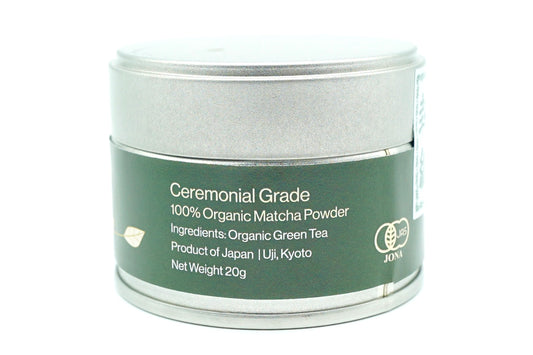
The JAS logo is Japan's organic certification. It means audited fields and a three-year conversion before the tea can carry it, and only around 5% of the tea grown in Japan qualifies. The word "organic" on its own is a claim; the logo is a certificate. Look for the logo. Every tea we sell carries it, because we sell nothing else. What the certification covers is in What Is Matcha? A Beginner's Guide.
8. The ingredients line says matcha and nothing else
Turn the tin over. The ingredients line should read like ours: 100% organic matcha green tea powder, with the origin in brackets. Sugar, milk powder, flavour or "green tea powder" in that line means you are holding a latte mix or a blend, whatever the front says, and it should be priced as one.
9. The tin is small and the date is on it
Matcha is groceries, not pantry art. Buy what you will drink in two weeks in summer or a month in winter, and buy again; fresh beats fancy every time. A packed-on date beats no date. This is why our matcha starts at a 20 g tin (from $30) rather than a big bag: a tin you finish while it is bright is a better buy than a bag that goes dull on the shelf. Once opened, keep it sealed in the fridge and finish it within a few weeks. When a sealed tin comes out of the fridge, let it reach room temperature before opening, or it sweats.
10. The colour tells the truth
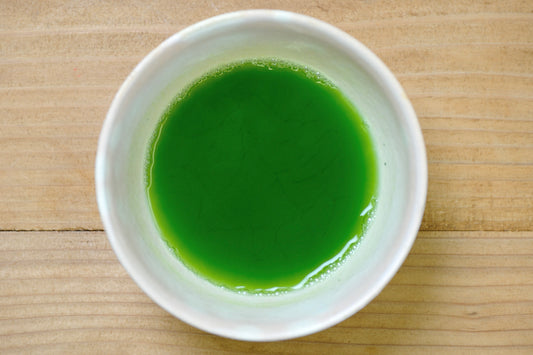
Good matcha is vivid green: the colour of the shading and the first harvest. Dull, yellowish or brownish powder usually means older stock or a lower grade. One related trap: vividly green "matcha" cakes and biscuits often lean on chlorella, an algae colourant that survives the oven. Pure matcha bakes olive, and that is the honest colour. Check the ingredients line on those too.
The Checklist
- Region named, town if possible
- First harvest stated
- Cultivar named
- Shaded, and for how long
- Stone-milled
- "Ceremonial" read past, not relied on
- JAS logo, not just the word organic
- Ingredients: matcha and nothing else
- Small tin, packed-on date
- Vivid green in the tin
What Ours Say
Our Kyoto matcha is from Ujitawara, first harvest, five named cultivars, shade-grown for at least twenty days, deveined and stone-ground, JAS certified, 100% organic matcha green tea powder (Kyoto, Japan), in a 20 g tin from $30. Our Kagoshima matcha is from Chiran, on the volcanic plateau, single cultivar Okumidori, first harvest, JAS certified, in a 20 g tin. Taka buys both directly from the farms and has visited the Kyoto grower three times. Every tea we sell is packed in Japan, and we keep our matcha in the fridge and freezer. Ships Australia-wide and worldwide, with free Australian shipping over $100.
All our organic matcha · How to make it once it arrives