Ceremonial vs Culinary Grade Matcha: How to Tell the Difference
Taka KanekoWalk into any café in Australia and matcha is on the board. Walk into any grocer and there are tins labelled "ceremonial grade" at fifteen dollars and at sixty. That label is doing a lot of work, and almost none of it is regulated. This guide explains what ceremonial and culinary grade actually mean, what physically separates the two powders, and how to check which one you are really holding.
It is written by Taka Kaneko, founder of EdoMatcha and one of only two Japanese Tea Instructors in Australia certified by the NPO Nihoncha Instructor Association, from the matcha we import directly from the farms that grow it. The Guardian quoted him on matcha preparation in August 2026.
The Short Answer
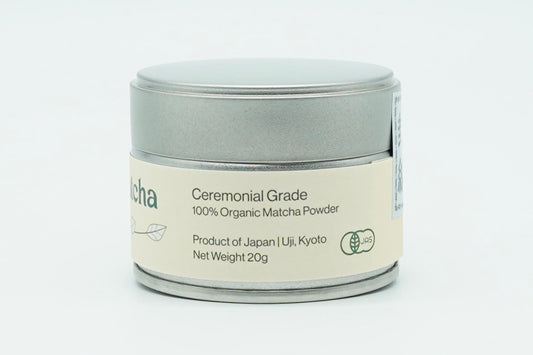
Ceremonial grade matcha is made to be whisked with water and drunk on its own. It should come from the year's first harvest, from leaves shaded before picking, stripped of stems and veins, and finely ground. It is sweet, deeply umami, vivid green and smooth.
Culinary grade matcha is made to be cooked, baked or mixed. It comes from later harvests, is usually milled coarser, and tastes stronger and more astringent, which is fine under sugar, milk and heat, and unpleasant on its own.
The catch is the next sentence: no law, in Japan or in Australia, defines either term. A seller can print "ceremonial" on anything. So the label tells you what the seller intends; the leaf tells you what you actually bought. The rest of this guide is about reading the leaf.
Where the Words Come From
Japanese producers do not usually grade matcha as "ceremonial" or "culinary". A Kyoto mill sells a range of matcha by name and by intended preparation: some for koicha (thick tea), some for usucha (thin tea), some for confectionery and cooking, and prices them by harvest, cultivar and how carefully the leaf was handled. "Ceremonial grade" is an English-language shorthand that appeared as matcha spread overseas: a way of saying "the kind you would use in a tea ceremony" as opposed to "the kind you would bake with".
As a shorthand it is useful. As a guarantee it is nothing. That is why two tins carrying the same word can be forty dollars apart and taste like different plants.
Ceremonial grade, explained on the EdoMatcha channel.
What Actually Separates the Two
1. Harvest timing: the biggest single factor
Tea bushes in Japan are picked more than once a year. The first picking of spring, ichibancha, is the youngest, most tender leaf, and it carries the sweetness and amino acids the plant stored over winter. Later pickings through summer are coarser, higher in the catechins that taste bitter and astringent, and cheaper to produce.
Genuine ceremonial matcha is first-harvest matcha. Culinary matcha is, almost by definition, made from later harvests. When a "ceremonial" tin tastes harsh, this is usually why: the word was on the label but the first harvest was not in the tin.
All three EdoMatcha matcha are ichibancha. It is the reason we say "first harvest" on every product page rather than leaning on the grade label alone.
2. Shading before harvest
For weeks before picking, bushes destined for matcha are covered so they grow in shade. Shading pushes the plant to make more chlorophyll and more theanine, the amino acid behind matcha's calm, rounded sweetness, and less of the bitter catechins. Leaf grown this way, then steamed and dried without rolling, is called tencha, and tencha is what becomes matcha.
Our Kyoto matcha, including SEN, is shaded for at least 20 days before picking. Culinary-grade leaf is shaded for a shorter period, or not at all, and the colour shows it: olive or khaki rather than jade.
3. What is removed before grinding
Good tencha is de-stemmed and de-veined before milling, leaving only the soft leaf flesh. Stems and veins are woody; they grind to a dull, gritty powder, and leaving them in is cheaper and adds weight. Ceremonial matcha is ground from the flesh alone. Culinary matcha often is not.
4. How it is ground
Ceremonial matcha is finely ground. Fineness is not cosmetic: it is why ceremonial matcha suspends evenly in water and whisks to a stable foam, while coarse matcha sinks, clumps and feels sandy on the tongue.
5. Freshness and storage
Matcha oxidises quickly once it meets light, air and heat. A first-harvest matcha stored badly for a year loses colour and sweetness and drifts toward the flavour of a culinary grade. Sealed tins, cool dark storage and buying quantities you will finish within a few weeks protect what the grade paid for.
How to Tell Which One You Are Holding
You do not need a laboratory. Five checks, in the order you can make them:
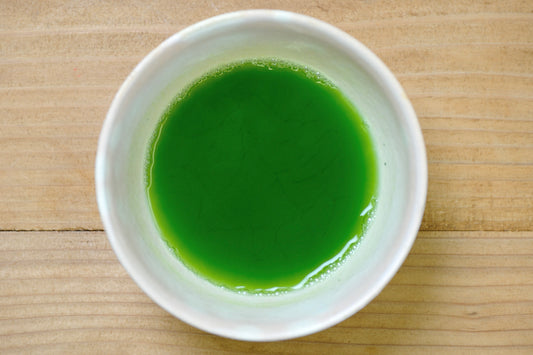
- Colour. Tip a little onto white paper. Ceremonial matcha is a vivid, almost electric green. Culinary matcha runs yellow-green, olive or dull.
- Texture. Rub a pinch between finger and thumb. It should feel like fine talc, with no grit at all.
- Aroma. Dry ceremonial matcha smells sweet, fresh and a little like the sea. Lower grades smell of hay, or of very little.
- Taste it with water only. Whisk 1.5–2g in 60–80ml at 70–80°C: our step-by-step method is here. Ceremonial matcha is sweet and umami with a clean finish. If it is only bitter, it is not ceremonial, whatever the tin says.
- Read the tin for facts, not adjectives. Look for a harvest ("first harvest", "ichibancha"), a named region and farm, a cultivar, and a certification mark. "Premium", "finest" and "ceremonial" are adjectives. "First harvest, Ujitawara, JAS organic" are facts.
Which Grade for Which Drink
| You are making | Use | Why |
|---|---|---|
| Usucha: a normal whisked bowl | Ceremonial | Nothing hides a bitter powder in a bowl of plain water. |
| Koicha: thick tea | Ceremonial, the best you have | Koicha uses much more powder in much less water; only the sweetest first-harvest matcha stays smooth at that strength. |
| Matcha latte | Ceremonial for a smooth latte; culinary for a strong one | Milk softens bitterness but does not remove it. A ceremonial latte tastes sweet and green; a culinary latte tastes stronger and usually needs sugar. |
| Iced matcha, smoothies | Either: ceremonial if you drink it unsweetened | Cold water mutes bitterness; sweeteners mute the rest. |
| Baking, ice cream, desserts | Culinary | Heat, sugar and fat flatten the finer notes you paid for. Save the ceremonial tin. |
 Why Ceremonial Matcha Costs More
Every step above costs money: weeks of shading, a single spring picking, sorting out stems and veins, fine milling, careful packing. A tin that skips any of them can be sold for less, and often is, under the same word.
The current shortage has sharpened this. With Japanese auction prices up sharply and some of Kyoto's best-known houses rationing sales, the temptation to stretch first-harvest leaf with later pickings, or to relabel culinary matcha upward, has never been greater. The five checks above are your protection.
For reference, our own tins: Kyoto matcha from Ujitawara is $30 for 20g, Kagoshima matcha from Chiran is $45 for 20g, and SEN, drawn from the very top of the Kyoto first harvest, is $45 for 20g. All three are ceremonial, first-harvest and JAS-certified organic. Only around 5% of the tea produced in Japan is organic. We sell nothing else.
"Organic" and "Ceremonial" Are Separate Claims
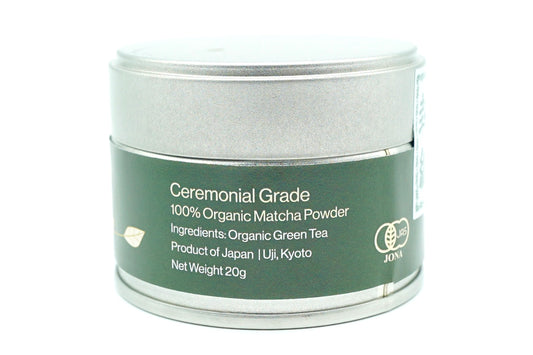
Ceremonial describes how the leaf was grown, picked and milled. Organic, JAS certification in Japan, describes how the field was farmed: no synthetic pesticides or fertilisers, verified by an independent body rather than declared by the seller. Most ceremonial matcha is not organic, and some organic matcha is culinary. When both are true of the same tin it is genuinely uncommon, because only about 5% of Japan's tea production is certified organic to begin with.
Questions People Ask Us
Can I use ceremonial matcha for lattes?
Yes, and it makes the better latte: smoother, sweeter, greener. Culinary matcha is not required for milk; it is simply what survives it.
Is culinary matcha lower quality?
It is the same plant, picked later and handled more roughly. For baking, that is the right tool, and paying ceremonial prices for something that goes into a cake is a waste. For drinking, it is the wrong tool.
Does "ceremonial" mean it is what tea ceremonies use?
Tea schools choose matcha from particular producers by name and by preparation, a koicha matcha or an usucha matcha, not by an English grade word. Very good ceremonial matcha would be at home in a tea room; the word alone does not put it there.
Is more expensive always better?
No, but genuinely first-harvest, shaded matcha cannot be cheap, so a very low price is a reliable warning. Above that floor, judge by the five checks and by your own bowl, not by the number on the tin.
What We Would Tell a Friend
Buy a small tin of genuine first-harvest matcha, taste it with water only, and remember that flavour. It becomes the reference point that makes every label afterwards easy to read. If you drink it in milk, buy ceremonial anyway. The difference is obvious in the cup. If you bake, buy culinary and do not feel bad about it; that is exactly what it is for.
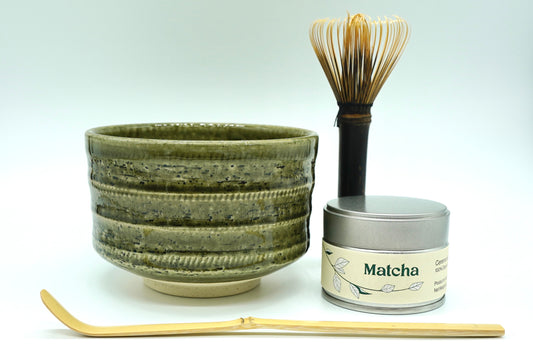
Shop organic ceremonial matcha · The Ceremony Kit: matcha, chawan and a Takayama chasen in one box · The matcha whisk guide · What is matcha? A beginner's guide
We ship Australia-wide and worldwide, with free Australian shipping over $100.