Matcha Benefits: What the Research Actually Shows (and What It Doesn't)
Taka KanekoSearch "matcha benefits" and you will be told it detoxes, burns fat, prevents cancer and replaces coffee without a single downside. Most of that is marketing. Some of it is real, and the real part is interesting enough that it does not need the rest. This article sets out what human studies actually show about matcha, what they do not, and how much caffeine is in the bowl in front of you.
It is written by Taka Kaneko, founder of EdoMatcha and one of only two Japanese Tea Instructors in Australia certified by the NPO Nihoncha Instructor Association. He is a tea instructor, not a doctor — so every claim below is linked to the study it comes from, and this is general information, not medical advice. The Guardian quoted him on matcha preparation in August 2026.
Why Matcha Is Different From a Cup of Green Tea
With steeped tea you drink water that has passed through the leaf and throw the leaf away. With matcha you drink the leaf itself, stone-ground and whisked into water. That single fact is behind most of what follows: whatever is in the leaf — its amino acids, its caffeine, its catechins — you consume more of it per bowl than you would from a teabag.
Three compounds do most of the work:
- L-theanine, an amino acid almost unique to tea, associated with relaxed attention.
- Caffeine — less per bowl than a cup of coffee, but present.
- Catechins, the family of polyphenols green tea is famous for, of which EGCG is the best studied.
The balance between them is not fixed. Matcha bushes are shaded for weeks before harvest, and shading measurably raises theanine and caffeine in the leaf while lowering catechins (Chen et al., 2022). That is why a properly shaded, first-harvest matcha tastes sweet and rounded rather than bitter — and why the grade you buy changes what is in the cup. If you want the background on grades, it is in our guide to ceremonial vs culinary matcha.
1. Calm, Steady Alertness — the Best-Supported Benefit
This is the one people describe unprompted: matcha wakes you up without the edge. The evidence behind it is the combination of L-theanine and caffeine.
A 2025 systematic review and meta-analysis of randomised controlled trials in Nutrition Reviews found that L-theanine combined with caffeine improved alertness and the accuracy of switching attention between tasks in healthy adults (Nutrition Reviews, 2025). One of the underlying trials gave 44 young adults 97 mg of L-theanine with 40 mg of caffeine — modest, tea-like amounts — and measured better task-switching accuracy, higher self-rated alertness and lower tiredness than placebo (Giesbrecht et al., 2010).
How does a bowl compare with those doses? In a 2024 Japanese trial, 2 grams of matcha — a standard bowl — delivered about 48 mg of theanine and 170 mg of catechins (Uchida et al., 2024). Theanine and caffeine levels vary with grade, harvest and shading, so treat those as a reasonable middle figure rather than a guarantee.
2. Catechins and Antioxidants — Real Content, Modest Effects
Matcha is unusually rich in catechins because you consume the whole ground leaf. A frequently cited 2003 analysis measured EGCG at about 57 mg per gram of matcha powder (Weiss & Anderton, 2003). You will also see that study quoted as proving matcha has "137 times" the EGCG of green tea. Be careful with that number: it compared solvent-extracted matcha powder with a single brand of bagged tea brewed in water. Matcha does contain considerably more catechins than a cup of steeped green tea — but not by a factor you can put a precise number on.
What do catechins do in people? The honest answer from trial evidence is "a little, reliably". Meta-analyses of randomised trials of green tea or green tea catechins report small reductions in blood pressure — roughly 2 mmHg systolic and 1.7 mmHg diastolic (Khalesi et al., 2014) — and small reductions in total and LDL cholesterol, on the order of a few mg/dL (Kim et al., 2011; Xu et al., 2020). Those are population averages from green tea and catechin extracts, not matcha-specific trials, and they are the kind of effect that supports a healthy routine rather than replacing one.
3. Stress — Some Evidence; Mood — Not Really
A 2023 critical review of human and animal matcha studies concluded that matcha consumption decreases stress and slightly enhances attention and memory, while the randomised trials that measured mood found no effect (Sokary et al., 2023). That is worth saying plainly because "matcha lifts your mood" is one of the commonest claims online. The better-supported version is narrower: a bowl helps you stay attentive under mild stress without adding to it.
4. Thinking and Sleep in Older Adults — Early, Mixed
The largest long-term matcha trial so far followed 99 older adults with mild cognitive complaints for twelve months, half of them taking 2 g of matcha a day. The matcha group improved on recognising emotions in facial expressions and reported better sleep quality; broader cognitive scores did not differ from placebo (Uchida et al., 2024). A separate four-week placebo-controlled trial in 46 healthy adults found no change in sleep measured by EEG, but better self-rated sleep quality and emotional stability in the matcha group (Baba et al., 2024). Encouraging, not conclusive — and reviews of the cognition evidence still describe it as mixed.
How Much Caffeine Is in a Bowl of Matcha?
Studies put matcha at roughly 20–45 mg of caffeine per gram, varying with grade, harvest and shading (Kochman et al., 2021). A standard bowl uses 1.5–2 g, so most bowls land below a standard cup of brewed coffee and around the level of a single espresso (Healthline). Because the caffeine arrives with theanine, most people experience it as gentler — that is the point of section 1, not a claim that the caffeine is absent.
For context, the European Food Safety Authority considers habitual intakes of up to 400 mg of caffeine a day safe for healthy adults, and up to 200 mg a day during pregnancy (EFSA, 2015). Two or three bowls of matcha sit comfortably inside that; if you want the ritual with less caffeine, hojicha powder — roasted green tea — is the usual answer.
What Matcha Does Not Do
- It does not "detox" you. Your liver and kidneys do that; no food switches them on.
- It is not a weight-loss product. The trials behind that claim used concentrated green tea extracts at doses no bowl provides, and the effects were small even then.
- It does not treat or prevent disease. The cholesterol and blood-pressure findings above are small average shifts in study populations, not a therapy. If you are managing a condition or taking medication — blood thinners in particular — talk to your doctor before making tea a daily habit.
- Extract studies are not bowl studies. Many headlines come from capsules delivering many times the catechins of a cup. A bowl of matcha is a food, and its benefits are food-sized.
Getting the Most From It
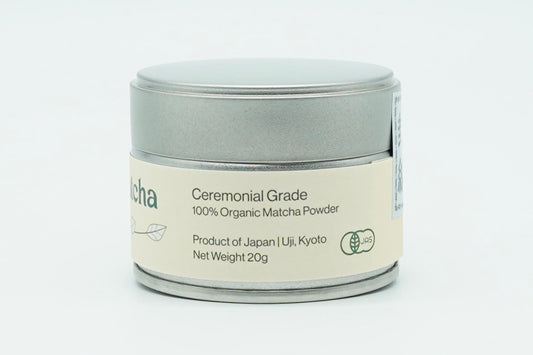
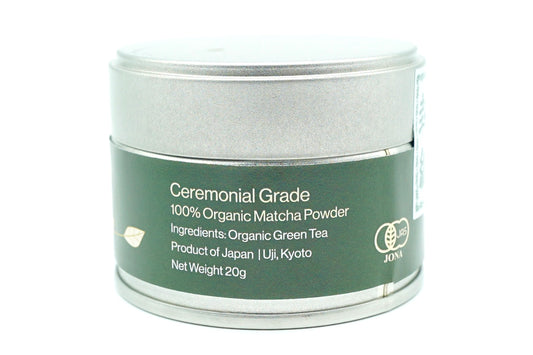
- Buy first-harvest, shaded matcha. Shading is what raises theanine; later, unshaded harvests are higher in bitter catechins and lower in the amino acid that makes matcha feel calm. All three of ours are first harvest (ichibancha), shade-grown and JAS-certified organic — only around 5% of the tea produced in Japan is organic, and we sell nothing else.
- Prepare it properly. 1.5–2 g into 60–80 ml of water at 70–80°C, whisked in an "M" shape. Boiling water scorches it. The full method is here.
- Drink it plain at least sometimes. Milk and sugar are fine — a matcha latte still carries the leaf — but plain usucha is where you taste whether your matcha is any good.
- Store it sealed, cold and dark, and buy amounts you will finish within a few weeks. Catechins and colour both fade with light and air.
Shop organic ceremonial matcha · The Ceremony Kit — matcha, chawan and a Takayama chasen · What is matcha? A beginner's guide · Video guides
We ship Australia-wide and worldwide, with free Australian shipping over $100.
Sources
- Nutrition Reviews (2025). Effects of tea, L-theanine, or L-theanine plus caffeine on cognition, sleep and mood: systematic review and meta-analysis of RCTs. academic.oup.com
- Giesbrecht T. et al. (2010). The combination of L-theanine and caffeine improves cognitive performance and increases subjective alertness. Nutritional Neuroscience. PubMed
- Uchida K. et al. (2024). Effect of matcha green tea on cognitive functions and sleep quality in older adults with cognitive decline: a 12-month RCT. PLOS ONE. journals.plos.org
- Baba Y. et al. (2024). Matcha does not affect EEG during sleep but may enhance mental well-being: a randomised placebo-controlled trial. PMC
- Sokary S. et al. (2023). The therapeutic potential of matcha tea: a critical review on human and animal studies. Current Research in Food Science. PMC
- Kochman J. et al. (2021). Health benefits and chemical composition of matcha green tea: a review. Molecules. PMC
- Weiss D.J. & Anderton C.R. (2003). Determination of catechins in matcha green tea by micellar electrokinetic chromatography. Journal of Chromatography A. ScienceDirect
- Chen X. et al. (2022). Effect of shading on the morphological, physiological and biochemical characteristics as well as the transcriptome of matcha green tea. International Journal of Molecular Sciences. PMC
- Khalesi S. et al. (2014). Green tea catechins and blood pressure: systematic review and meta-analysis of RCTs. PubMed
- Kim A. et al. (2011). Green tea catechins decrease total and LDL cholesterol: systematic review and meta-analysis. PubMed · Xu R. et al. (2020). Effect of green tea consumption on blood lipids: meta-analysis of RCTs. PMC
- EFSA (2015). Scientific opinion on the safety of caffeine. efsa.europa.eu