Organic Matcha: What JAS Certification Actually Means
Taka KanekoOnly about 5% of the tea grown in Japan is certified organic, and every tea we sell is. That sentence does a lot of work on this site, so this post explains the part behind it: what JAS certification actually requires, who checks it, why so few farms clear it, and how to read the mark on a tin. None of it is marketing. It is the law the certification sits on, as it is taught in the Japanese tea instructor course.
The short answer: on a tin of organic matcha, the JAS mark means no chemically synthesised agrochemicals, fertilisers or soil improvers, on a field that has had none for three years or more, with the factory certified too, all checked by a registered third party.
It is written by Taka Kaneko, founder of EdoMatcha and one of only two Japanese Tea Instructors in Australia certified by the NPO Nihoncha Instructor Association.
In Japan, "Organic" Is a Legal Word
JAS is the Japanese Agricultural Standard, the national standards system for food and farm produce. In July 1999 the JAS law was amended to make the certification and labelling of organic produce a matter of law, and the amendment came into force on 1 April 2001. Since then, only produce from a producer certified by a registered third-party certification body may be labelled or sold as organic in Japan. Putting "organic" or "オーガニック" on a packet without the mark is prohibited by law, not merely frowned on.
So on a Japanese label the word organic is not an adjective. It is a certificate, and it is checked.
What the Mark Requires
- No chemically synthesised agrochemicals, fertilisers or soil improvers. Not fewer. None.
- A clean field for three years or more. The field must have received none of those inputs for at least three years before its produce can carry the word. A field one to three years into conversion may be certified as "in conversion", and its produce must say so on the label.
- No mixing. Organic produce cannot be blended with produce that is not organic, and it must be handled in a plant that keeps the two apart.
- The whole chain, not only the farm. Tea counts as a processed food under the law, so the field is certified and so is the factory that makes the leaf into tea, and so is anyone who repacks it. If any link in that chain is not certified, the final product cannot be labelled organic.
Who Checks
Certification is done field by field by a registered certification body, and what is certified is the producer's production-process management: how each field is farmed, recorded and kept separate. That is what "audited fields" means when we say it in the workshop. The certifier is a third party, not the farm and not the seller.
Why Only About 5%
Look again at the requirements and the number stops being surprising. A tea field is a set of bushes that are farmed for decades, so converting one is not a season's decision. It means three full years of farming without synthetic inputs before a single leaf can carry the word, and with an audit at the end. Then the factory has to be certified as well. Most growers, reasonably, do not. Ours have been doing it for a long time: our Kagoshima grower in Chiran has farmed organically for around thirty years, and the Oku-Yame farm behind our gyokuro, genmaicha and hōjicha leaf for over forty.
How to Read the Label
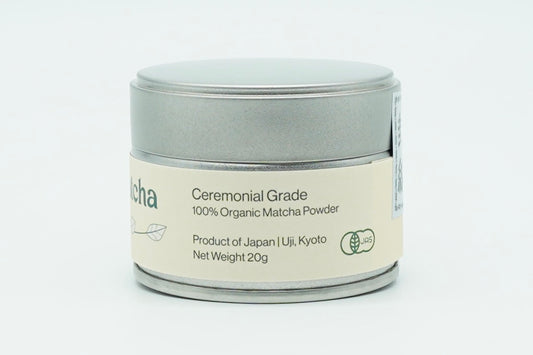
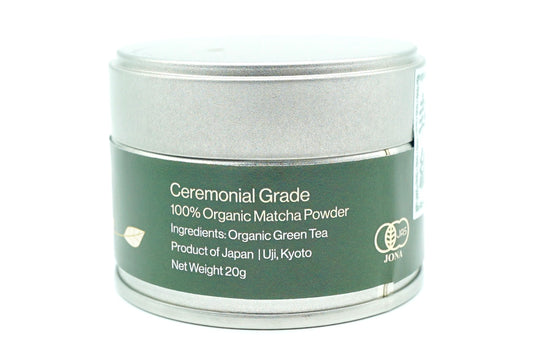
The organic JAS mark is a small seal of two overlapping circles: where they overlap is a leaf, and the letters JAS sit in the right-hand circle. On a Japanese packet the name of the produce must also carry the word in a set form, such as 有機 or オーガニック before or after the name of the tea. Outside Japan, look for the mark itself or the name of the certifying body on the packet. A tin that says organic in the marketing copy and shows no mark is making a claim; a tin with the mark has been certified. Our tins carry it, and the certification is verified by Japanese and international bodies. The JAS logo is point 7 in our ten-point checklist for buying matcha in Australia.
What Organic Does Not Mean
It is not a grade. Organic says how the tea was grown, and quality is a separate question. The things that decide quality are the harvest, the shading, the cultivar and how finely the leaf is ground, which we cover in Ceremonial vs Culinary Grade Matcha. We answer both questions: each of our matcha pages says first harvest and shade-grown, and the tin carries the JAS mark.
It is also not a health claim. We will not tell you organic matcha does anything to your body that other matcha does not, because we cannot show it. What we can point to is the certification itself.
Our Teas
Every tea we sell is JAS-certified organic, and we buy each one directly from the people who make it. Kyoto matcha from Ujitawara, from the family who were our first supplier. Kagoshima matcha from Chiran, on the volcanic plateau. Gyokuro, genmaicha and hōjicha leaf from Oku-Yame in Fukuoka. All of these are first harvest. Ships Australia-wide and worldwide, with free Australian shipping over $100.
All our organic matcha · All our organic Japanese tea
Common Questions
Is organic matcha better?
It is grown differently, and that is the honest answer. Quality comes from the harvest, the shading and how finely the leaf is ground. We sell only organic because of how we want the fields farmed, and we choose first-harvest, shade-grown tea within that.
Does JAS organic mean no pesticides at all?
It means no chemically synthesised agrochemicals, fertilisers or soil improvers, on a field that has had none for three years or more, checked by a third party. That is the standard as written.
Is JAS the same as the organic standards in other countries?
The Japanese standards for organic food are set in line with international standards. Our tins carry the Japanese mark, and the certification is verified by Japanese and international bodies.
Why do some Japanese teas say "in conversion"?
Because the field has been farmed organically for one to three years and has not yet reached the three-year mark. The law allows the label, and it requires the words to be there.