Know Your Chawan: How to Choose a Japanese Matcha Bowl
Taka KanekoOf all the objects on a tea table, the matcha bowl is the one people fall for. It's also the piece with the least guidance attached: shops will happily tell you a bowl is "authentic" and "handcrafted" without ever explaining what makes a bowl good for matcha, or why chawan even look the way they do.
This guide is by Taka Kaneko, founder of EdoMatcha and one of only two Japanese Tea Instructors in Australia certified by the NPO Nihoncha Instructor Association. It covers what physically makes a chawan work, how to choose between shapes and glazes, and how to look after handmade ceramics, whether the bowl comes from us or not.
Why a Matcha Bowl Is Shaped Like That
Matcha isn't steeped and strained like leaf tea. The powder is suspended in water by whisking, a fast, wrist-driven "M" motion with a bamboo chasen, and that motion needs space. Every feature of a chawan follows from it:
- The wide mouth gives the whisk room to travel. In a mug, the chasen hits the walls before the "M" ever gets going.
- The rounded inner wall lets the whisk sweep smoothly with no corners for powder to hide in. This is where lumps go to survive in the wrong vessel.
- Depth without narrowness keeps 60–80ml of tea and a working whisk inside the bowl instead of on your bench.
- The foot (kōdai), the raised ring underneath, lifts the hot bowl off the table and gives your fingers somewhere to sit when you drink with both hands.
A bowl that gets these right makes whisking feel easy on your first attempt. A bowl that doesn't will fight you every morning, however beautiful it is.
Choosing a Chawan: What Actually Matters
Size and weight
You want a mouth wide enough for a relaxed whisking action and a bowl that feels secure held in two hands. Chawan are drunk from directly, so the hold matters as much as the look. Pick it up in your imagination when you're browsing: a very light bowl can feel skittish under a fast whisk; a very heavy one turns a daily ritual into a workout.
Colour, inside and out
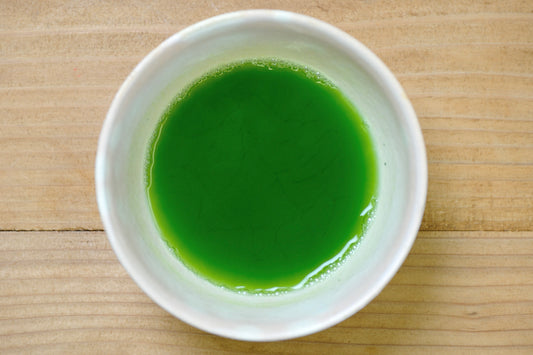
Here's the choice nobody explains: the inside of the bowl is the backdrop for the tea. A pale or white interior shows matcha's colour honestly, which is useful when you want to see exactly how vivid (or tired) your powder is. A dark glaze does the opposite trick: whisked matcha glows almost neon against it. Neither is wrong. Many people end up with one of each, and that is a perfectly respectable way to build a shelf.
Glaze and texture
Every bowl in our chawan collection is handmade in Japan, which means glazes that move (drips, pools, speckles, crackle) and no two bowls quite alike. Run your eye over the rim too: a smooth, slightly rounded lip is what your mouth meets every day. Texture on the outside is character; texture on the drinking edge is a design flaw.
Katakuchi: the bowls with a spout
Some of our chawan, like the Ginga Katakuchi and Oribe Katakuchi, have a small pouring lip. Katakuchi means a spouted vessel, and it makes these bowls quietly brilliant for the way most Australians actually drink matcha: whisk in the bowl, then pour cleanly over milk or ice for a latte. One vessel, no funnel, no drips.
Season and mood
In traditional tea practice, bowls change with the calendar: more open, shallower forms let tea cool in warm months, while taller, thicker-walled bowls hold their heat in winter. You don't need a seasonal wardrobe of chawan, but it's a lovely lens for a second bowl: one for July, one for January.
What Chawan Cost, and Why
Our bowls run from $45 to $147. The differences are size, the complexity of the glaze work, and how much hand-finishing a form demands, not "authenticity", which is the same for all of them: handmade in Japan, chosen by us in person. A $45 bowl whisks exactly as well as a $147 one. The extra money buys the glaze you can't stop looking at, and that's a legitimate thing to pay for in an object you'll hold every day.
Do You Even Need One to Start?
Honest answer: no. A deep cereal bowl with a rounded inside will get you whisking tonight, and we say so in every workshop. The chawan is the piece you graduate into, usually about a month in, once the ritual has stuck and you've caught yourself drinking from the kitchen bowl while looking at nicer ones. When that happens, you'll also know your taste: pale or dark, smooth or stony, plain or wild.
Caring for a Handmade Bowl
- Rinse promptly, wash gently. Warm water and a soft hand; matcha rinses clean without scrubbing. Skip the dishwasher. Handmade glazed stoneware doesn't enjoy the thermal shock or the knocking about.
- Dry fully before putting it away, especially bowls with an unglazed foot, which can hold moisture.
- Avoid extremes. Don't pour boiling water into a cold bowl straight off a winter shelf. Warm it first with a swirl of warm water (which also happens to be proper matcha technique).
- Use it. Ceramics kept "for good" serve nobody. A chawan's job is Tuesday morning.
Questions People Ask Us
What size is right for one bowl of matcha?
A standard bowl of usucha is only 60–80ml of water plus foam, so almost any proper chawan has room to spare. The width is for the whisk, not the volume.
Can I use my chawan for anything else?
Absolutely. They make beautiful bowls for morning porridge, rice, or ice cream. We'd rather see a chawan used daily for everything than kept in a cupboard for ceremony.
Bowl first or whisk first?
Whisk first. The chasen has no substitute; the bowl has a stand-in already in your kitchen. The full logic is in the matcha whisk guide, and if you'd rather choose everything at once, the Ceremony Kit pairs any of our twenty-four chawan with a Chikumeido chasen and your choice of matcha in one box.
How do I whisk once I have one?
Sift 1.5–2g into the bowl, add 60–80ml of water at 70–80°C, whisk in an "M" from the wrist until the foam is fine and even. The complete method is in How to Make Matcha.
Shop matcha bowls (chawan) · The Ceremony Kit · Organic ceremonial matcha · The matcha whisk guide
We ship Australia-wide and worldwide, with free Australian shipping over $100.